-
Spain- New regulation on the access and use of the UBO Register

Martin Kenney, the oracle of the BVI This post is dedicated to my good friend and ICC FraudNet fellow member, Martin Kenney, “the oracle of the BVI”.
Martin had long proclaimed that unrestricted access to beneficial ownership registries was contrary to the right to privacy and would have a counterproductive effect in terms of asset tracing and recovery.
As is well known, CJEU judgment of November 22, 2022 (Case No. C-37/2022) declared just that, proving Martin right.
The CJEU declared in such judgment the invalidity of EU Directive 2015/849, which provided that Member States had to ensure that information on UBOs had to be made available to the general public in all cases.
The CJEU considered that such provision violates Articles 7 and 8 of the EU Charter of Fundamental Rights regarding the right to privacy and the right to the protection of personal data.
The aftermath of the CJEU ruling
Obviously, the consequences of this decision have been that the authorities of the EU Member States have had to adapt to the new criteria established by the CJEU.
The Spanish authorities have done so relatively “quickly”.
The new regulation, issued just last week (Royal Law-Decree 5/2023, of 28 June) adapts Spanish law to such ruling. It ensures that only parties with due diligence obligations (according to anti-money laundering regulations) will have access to the information contained in the Ultimate Beneficial Ownership Register (“UBOR”).
They will also be able to obtain an extract from it, in order to comply with their obligations regarding the identification of the beneficial owner.
Right of access to the person with legitimate interest
In addition, all other persons or organizations that can demonstrate a legitimate interest shall have access exclusively to data consisting of:
(i) the name and surname,
(ii) month and year of birth,
(iii) country of residence and
(iv) nationality of the current UBO of a legal person or entity or structure without legal personality.
Access to the information available in the UBOR will require the prior identification of the applicant and the evidence of the legitimate interest.
But what is “legitimate interest”?
Spanish authorities have declared they will establish a list of “presumptions” of legitimate interest, but it remains to be seen whether this list will facilitate or hinder access to the UBOR.
In any case, the requirement to provide proof of the legitimate interest may certainly pose an obstacle to access.
Only experience will allow us to say whether such possible difficulties will be justified or whether, in practice, they will amount to a virtual impossibility of accessing the information.
What information will the UBOR contain?
On any case, the “future” UBOR (not yet in force, but expected to become fully operational before the Spanish general elections scheduled for July 23, 2023) will contain UBO information relating to:
- Spanish legal entities (and entities or structures without legal personality) that have the seat of their effective management or their main activity in Spain, or that are managed or administered by persons resident or established in Spain.
- Entities (or structures without legal personality) that are not managed nor registered in Spain nor another EU Member State, which intend to establish business relations, carry out occasional operations or acquire real estate in Spain.
The information will cover UBO available in public registries, such as:
- Registries of Spanish Foundations (state and regional).
- Registries of Spanish Associations (state and regional).
- Spanish Companies Register.
- Information obtained by the General Council of Notaries.
- Information and data on all legal entities, foreign “foundation-type” entities such as trusts and unincorporated entities or structures that do not declare their real ownership, which will be obliged to declare this information directly to the Register.
Sanctions will apply for the lack of declaration of the relevant information to the UBOR.
-
Piercing the corporate veil in Spain

Photo by Daisy Anderson on Pexels.com Avoiding the use of legal entities to commit fraud
One of the most important elements of company law is the limitation of the liability of the partners or shareholders.
It is of course permissible to articulate business activities through a company, so that the personal assets are protected from the eventual outcome of the company. However, this separation of assets must not be used in a fraudulent manner, amounting to what is known under Spanish law as “abuse of legal personality”.
Spanish case law has constructed its own mechanisms to combat possible abuses of legal personality, making use of the lifting of the corporate veil doctrine, first developed in Spain by a Supreme Court ruling of 28 May 1984 that has been used and developed ever since in virtually all areas of law.
It is generally understood that this inappropriate use occurs when the purpose of the company is not that which is proper to it (the exercise of commercial activities) but the mere avoidance of personal liabilities.
Requirements of the Spanish “piercing the corporate veil” doctrine
The doctrine will be perfectly applicable when the requirements for assessing such possible fraud are met, namely: (i) control of several companies by the same person; (ii) related-party transactions between those companies; (iii) lack of economic and legal justification for those transactions.
When this type of situation arises, in which intra-group transactions serve no purpose other than fraud, diverting for example the funds of the company that has debts to another company that does not, to the obvious detriment of the creditors of the former, the courts apply the doctrine of piercing the veil, thus rendering ineffective the apparent transactions that have constituted the abuse.
Once this first judicial formulation of the doctrine was carried out in Spain, a significant number of decisions, both by the Supreme Court and the Courts of Appeal, as well as by the Courts of First Instance, have led to its full confirmation and progressive use until it can be said that it has become an institution of judicial creation fully integrated into all areas of Spanish law.
Piercing the veil in civil-commercial and insolvency matters
It is in the civil-commercial sphere where the doctrine of lifting the corporate veil has had its confirmation and development through a body of case law that has been shaping and delimiting it.
One of the guidelines that Spanish jurisprudence has always been clear about this doctrine has been its necessarily restrictive application.
On the other hand, having clarified its restrictive nature, the doctrine cannot be applied “ex officio” by the judge.
Although there have been different attempts made by Spanish doctrine to classify the cases in which it is understood that the doctrine could be used, it is understood in case law that these are not “numerus clausus”.
It is frequently used, for example, in cases of misuse of the legal personality to the detriment of creditors, when the sole or majority shareholder normally empties the debtor company of its business and assets to continue with the same business and operations by setting up a new company and thus evade liability for the obligations assumed by the first entity. An example of fraudulent succession of companies can be found in the Supreme Court ruling of 20 December 2017, which condemns a company that formally did not contract the debt to pay it.
In insolvency matters, the doctrine is also applicable, among others, in: (i) claw-back actions (ii) for credit-ranking purposes (iii) determination of personal liabilities for the causation or worsening of the insolvency (iv) opening of joint insolvency proceedings (v) To resolve third-party claims, particularly when denying the status of third party to the company “confused” with the foreclosed company.
The Supreme Court Judgment of 30 January 2018 goes a step further by extending the application of the doctrine to consumer matters, by extending the contractual liability of the developer to the construction company against individual owners in a claim for construction defects.
Piercing the veil in criminal matters
In criminal law we can find frequent use of the doctrine of lifting the corporate veil, mainly in matters of economic criminal law, tax offences, as well as in the claim for civil damages caused by the criminal offence, where the perpetration of the crime occurs precisely by means of the interposition of “apparent” companies.
In terms of tax avoidance, we can cite the Supreme Court ruling of 8 June 2018, according to which, through a different company, income was concealed that belonged to another. Or the most recent ruling of the same Court dated 18 September 2018 on the avoidance of the special tax on hydrocarbons.
We can also apply it to crimes of embezzlement of public funds to clarify whether we are dealing with a public official or not. Thus, the Supreme Court ruling of 8 February 2018 states:
Or in matters of crimes of misappropriation as in the judgement of the same Chamber dated 21 February 2017 or 30 November 2016.
And the lifting of the veil has been applied with similar forcefulness in money laundering offences. Thus, by way of example, the Supreme Court ruling of 22 October 2013.
In short, we can say that in criminal law, we have seen an increasing use of the doctrine of lifting the veil, mainly for the prosecution of crimes committed using front companies.
The Spanish State General Prosecutor’s Office instructed Spanish public prosecutors to invoke the piercing of the corporate veil, notwithstanding the also available criminal liability of legal entities (Circular Letter 1/2011, dated 1 June 2011).

Photo by Pedro Figueras on Pexels.com Piercing the corporate veil in employment matters
Special mention should be made of the doctrine of lifting the veil in the employment law sphere, as here its justification is given by the specific need to identify the true centre of business management, especially in those cases in which the employer is a group of companies, as well as in those in which the employer hides behind the screen of a company that acts as an apparent employer.
It can be said that, although it was created by commercial doctrine and formulated in case law in the civil sphere, for some years now in Spain there has been a consolidated line of case law by labour courts.
In addition to the cases of groups of companies, the doctrine of lifting the veil is also fully effective in cases of company succession, i.e., those cases in which the intention is to circumvent the employee’s employment rights by means of a transfer of ownership of the company carried out with abuse of the legal personality by the employer.
Piercing the corporate veil in tax matters
In the field of taxation, it was regarding the personal income tax from work concealed by certain sportsmen and sportswomen -by means of interposed special purpose vehicles- that the courts resorted to the use of the doctrine of lifting the veil during the 1990s.
However, it was not until the decision of the Supreme Court of 19 April 2003 that the latter accepted the application of the doctrine to resolve a case of tax evasion using shell companies.
Since that date, there have been frequent cases in the tax sphere, whether in liquidation or collection matters, in which the Spanish Courts have resorted to the use of the lifting of the veil doctrine.
In fact, it could be said that the doctrine has gradually become part of tax legislation itself. Thus, the current wording of section 6 of Article 170 of the General Tax Law is inspired by the doctrine when, in precautionary measures, it ignores the legal personality of the company in cases where the taxpayer “exercises effective control, total or partial, direct or indirect, over the company of the owner of the property“. In addition, Article 43 of the same Law, sections g) and h), in listing subsidiary liable parties, includes the case that “it is proven that the legal persons have been created or used abusively or fraudulently to evade the universal patrimonial liability to the Treasury and there is a single person or economic sphere, or confusion or diversion of assets“.
In terms of case law, Courts recognise the doctrine of lifting the veil as a “complementary” technique to combat tax avoidance, in a case in which taxation on corporate income tax was avoided by charging high interest on a debt to one of the non-resident group of companies; or the case where a company was set up to provide professional consultancy services actually rendered on a personal basis.
Piercing the corporate veil in administrative litigation
In the administrative litigation sphere (i.e., litigation by private individuals/companies against the State), the application of the lifting of the veil doctrine is accepted without objection, based on the same arguments offered by the civil jurisdiction. Thus, the judgement of the Supreme Court of 16 April 2008, regarding the reimbursement of a public subsidy, states that “the legal figure of lifting the veil has been used to overcome the abusive use of the legal personality of companies”.
However, despite this admission of the doctrine, in general, it has been scarcely used by this jurisdiction, which prefers to resort to the generic institutes of “fraud of law” and/or “abuse of rights”, mainly in cases of extensions of liability for public debts, sanctions or the patrimonial liability of the State.
-
Don’t come to me with “Achmeas” nor “Komstroys”- ICSID “Antin” award fully enforceable in England against Spain, according to English Court

Photo by Pixabay on Pexels.com A London court ruled on 24 May 2023 that Spain can’t use state immunity nor EU law to avoid paying a €120 million ICSID arbitration award (the Antin award) for cutting back its economic incentives for renewable energy projects.
The investors, Infrastructure Services Luxembourg SÀRL and Energia Termosolar BV, argued that Spain was bound by its arbitration clause as a signatory to the Energy Charter Treaty Spain was seeking to set aside a January order that registered the arbitral award in England.
Spain’s challenge to the recognition of the Antin award by English Courts was based on grounds of sovereign immunity and European Union case law (mainly, the Achmea and the Komstroy cases).
In the wake of the Court of Justice of the European Union (CJEU) rulings in the mentioned cases, the judgment clarifies, from the point of view of English law, a protracted international legal argument regarding the legality of intra-EU arbitration awards. The London High Court ruled that those cases had no bearing on the Antin ICSID award’s ability to be enforced in England.
In addition, the combined effect of Article 54 of the ICSID convention and Section 2(2) of the State Immunity Act 1978 has also been decided for the first time in an English court to constitute a submission by a signatory state to the jurisdiction for the registration of ICSID awards in England.
English practitioners are now be able to shamelessly promote England as an enforcement-friendly jurisdiction for international arbitral awards involving non other than EU parties…
It’s no surprise that the judgment has been very well-received by practitioners of international arbitration and enforcement specialists throughout the common law world.
At the end of the day, this is not a matter of Spanish national pride because the mess was created by the CJEU. Its legal doctrines simply do not stick together as a matter of international law. And so says no less than a High Court in London.
The CJEU is a dogmatic giant with feet of clay. Its brilliant jurisprudence is rendered ineffective as soon as it crosses the borders of the EU. This is a matter of concern that undermines the credibility of the whole EU legal system. It is something that should lead to reflection by judges and policy-makers.
Usually, when a door closes, a window opens. And that window is being opened by common law jurisdictions. In the case of investors in renewable energies, these jurisdictions are not just England, but also the USA, Australia and even the BVI. These are offering legal shelter to EU investors, who have to flee their own home, unprotected by the “community of law” that the European Union falsely claims to be.
Or what did the CJEU think? Not everything had to be bad about Brexit, after all!
Congratulations to my good friend Nick Cherryman for obtaining this landmark victory.
-
ICC Spain’s podcast on “Arbitration & Asset Recovery”

I was happy to discuss all things “Arbitration & Asset Recovery” ahead of our Madrid event on the same topic of June 17.
Thank you ICC Spain for the opportunity.
You can listen to the podcast here (in Spanish).
-
“Arbitration & Asset Recovery” event in Madrid on June, 17 – Registrations now open!

Registrations are now open for what promises to be an exciting event around “Arbitration & Asset Recovery” next June 17 at ECIJA in Madrid, Calle Serrano, 69.
The event is co-organized by ICC Spain and ICC FraudNet with huge thanks to our sponsors Grant Thornton UK LLP and Ramco Litigation Funding.
If you attend the Annual Congress of the Club Español del Arbitraje starting the next day, do not miss this chance and join us.
Please follow this link to register.
The program is as follows:
10.00 – 10.10: Welcome and opening words
Jordi Sellarés│Secretary General│ICC Spain
Héctor Sbert │Partner│ECIJA (Barcelona)
10.10 – 11.00: Starting with the end in mind: strategizing award enforcement from the outset of arbitration
Moderator: Miguel Casas│Partner│Casas & Lacambra (Andorra)
Speakers:
David Mizrachi│Partner│MDU Legal (Panamá)
Ben Herzberg│Partner│Bodenheimer (Berlín)
Fabio Nuñez del Prado│Partner│Rebaza Alcazar (Lima)
11.00 – 12.00: Asset tracing & recovery and arbitral award enforcement: the practitioner’s toolkit
Moderator: Patricia Saiz│Independent Arbitrator│Member ICC International Court of Arbitration
Speakers:
Prashan Patel│Partner│Grant Thornton (London)
Aïcha Brahma│Partner│Brahma Avocats (Morocco)
12.00 – 13.00: Enforcement of arbitral awards and third-party funding
Moderator: Librado Loriente│Partner│ECIJA (Madrid)
Speakers:
Clifford J. Hendel│Partner│Hendel IDR (Madrid)
Philip Marshall │KC│Seral Court (London)
13.00 – 13.30: Q&A– Closing remarks
Rodrigo Callejas│Partner│Carrillo & Asociados (Guatemala)│Executive Director│ICC FraudNet.
13.30 – 14.00: Cocktail│Tapas & Drinks
General registration fee: 50 €
ICC FraudNet and CEA members: 40 €
Here is the link to registration.
Come and join us!
-
25th Anniversary of UNCITRAL’s Model Law on Cross-Border Insolvency and Expert Group Meeting on Asset Tracing and Recovery in Insolvency Proceedings
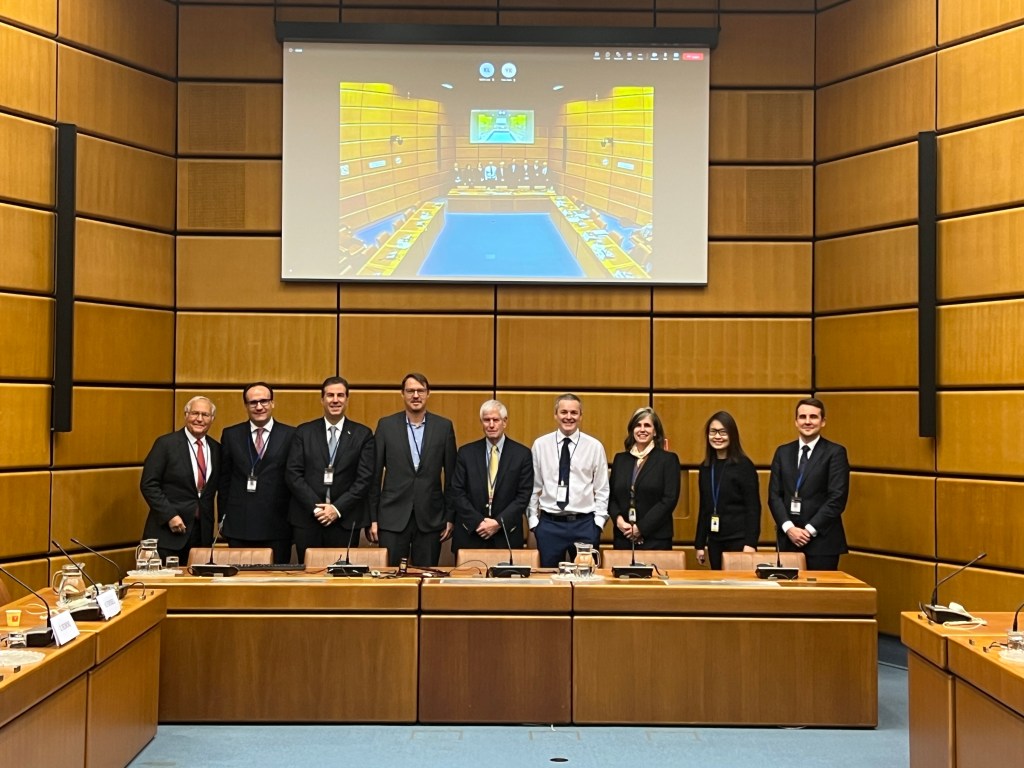
Some of the participants at the UNCITRAL’s Expert Group Meeting on Asset Tracing and Recovery in Insolvency Proceedings (from left to right): Steven Philippsohn (UK), Héctor Sbert (Spain), David Mizrachi (Panama), Henrique Forssell (Brazil), Christopher Redmond (USA), Shaun Reardon-John ( BVI), Karen Fellowes (Canada), Debby Lim (Singapore) and Jeremy Lightfoot (Hong Kong).
On 16 December 2022, during the 61st session of UNCITRAL Working Group V (insolvency Law) held in Vienna, I attended two interesting events: (i) a conference devoted to the 25th anniversary of the UNCITRAL Model Law on Cross-Border Insolvency; and (ii) Expert Group Meeting (EGM) on civil asset tracing and recovery in insolvency proceedings, convened by the UNCITRAL Secretariat.
It was a good opportunity to meet several fellow FraudNet members, as well as many other insolvency and asset tracing and recovery (ATR) specialists and discuss the future of ATR in insolvency contexts.
Conference commemorating the 25th anniversary of UNCITRAL’s Model Law on Cross-Border Insolvency
UNCITRAL’s Model Law on Cross-Border Insolvency (MLCBI) has been a pioneering text helping national insolvency laws address the challenges of cross-border insolvencies. Its importance cannot be underestimated given the complexity to harmonize globally such area of law. The MLCBI has now been implemented in 53 States throughout 56 jurisdictions (with EU Member States being among those “bad students” that have, unfortunately, shown less interest in following suit). It helps tackle international cooperation in insolvency matters, thus increasing the odds of saving viable business and liquidating non-viable ones, and to address the risk of asset concealment and dissipation to the prejudice of the insolvency estate.
During the morning of the 16 December, a conference was thus arranged to commemorate such anniversary and to review the application, interpretation, and use of the text. More than 100 people took part in the conference in person, including professors, judges and practitioners.
Expert Group Meeting on Asset Tracing and Recovery in insolvency proceedings
During the EGM on civil asset tracing and recovery in insolvency proceedings that took place in the afternoon, several working documents addressing civil asset tracing and recovery in insolvency proceedings were discussed.
UNCITRAL wishes to offer States a range of non-prescriptive ATR choices for legislation in their countries to, if necessary, improve their domestic ATR-related legal framework, especially with reference to cross-border ATR cooperation.
Such initiative was already discussed at an International Colloquium (Vienna, 6 December 2019) and in UNCITRAL’s Commission before being assigned to UNCITRAL Working Group V (Insolvency Law) in 2021.
A survey a ATR tools where discussed including:
- Preventive and provisional measures.
- Measures dealing with the identification of the insolvency estate assets.
- Control over the use and disposal of the assets of the insolvency estate and the operation of the debtor’s business.
- The powers of the insolvency representative.
- Avoidance actions.
- Actions against directors, shareholders and other related persons.
- Tools specifically designed for insolvency proceedings in an a cross-border context, particularly:
- Assistance to foreign insolvency proceedings and foreign representatives as per the MLCBI.
- Recognition of the foreign proceeding and the foreign representative (of both main and non-main insolvency proceedings).
- Direct communication and cooperation among courts and insolvency representatives.
Work will go on for the continued refinement of the definition of effective ATR tools in an insolvency context until the issuance of final recommendations to the States.
Congratulations to UNCITRAL and particularly to José Angelo Estrella-Faria, Samira Musayeva, Benjamin Herisset and Maria-Angeliki Giannakou for their excellent work and great cooperation.
-
Tracing of assets of the insolvency estate in the EU – the Proposal for a new Directive harmonizing certain aspects of insolvency law

Photo by Duu0161an Cvetanoviu0107 on Pexels.com On 7 December 2022, the European Commission published its “Proposal for a Directive of the European Parliament and of the Council harmonising certain aspects of insolvency law“. The Proposal is published when the previous Directive dealing with insolvency law (Directive 2019/1023 on preventive restructuring frameworks) is still in the process of being transposed to all EU Member States.
The scope of the new Proposal is broad and covers:
- avoidance actions;
- the tracing of assets belonging to the insolvency estate;
- pre-pack proceedings;
- the duty of directors to submit a request for the opening of insolvency proceedings;
- simplified winding-up proceedings for microenterprises;
- the drawing-up of a key information factsheet by Member States on certain elements of their national law on insolvency proceedings.
Title III of the Directive covers the tracing of assets belonging to the insolvency estate
In this respect, it is worth mentioning that the Proposal has been published less than 10 days before UNCITRAL’s Group V on Insolvency Law meets in Vienna, on 16 December 2022, to discuss a similar initiative about asset tracing and recovery in insolvency proceedings (three years after a first Colloquium at UNCITRAL kicked-off the discussion).
This coincidence proves the importance that asset tracing and recovery is gaining in the international arena. It is expected that, as a result of the meeting, UNCITRAL will also issue a legislative text containing recommendations on the subject.
More powers for insolvency practitioners
On any case, according to the Explanatory Memorandum of the Proposal, the new Directive should aim “to maximize the recovery of value from the insolvent company for creditors”. For this purpose, “the provisions on avoidance actions and asset tracing mutually reinforce each other”. They do so by “introducing a minimum set of harmonized conditions for exercising avoidance actions” and also by giving more powers for insolvency practitioners, by granting them access to:
- Bank account information
- Beneficial ownership information
- Certain national asset registers, including those from other Member States.
A “targeted intervention”
The Explanatory Memoradum also mentions that Title III is a “targeted intervention”, to be put in context of the Regulation (EU) 2015/848, establishing that insolvency practitioners may exercise also in other Member States the powers conferred on them by the law of the Member State where the main insolvency proceedings have been opened.
In such regard, the Proposal grants more powers to insolvency practitioners than those they currently have in most EU Member States. For example, the powers of insolvency practitioners to access beneficial ownership registries is unheard of in most EU jurisdictions for domestic insolvency proceedings, let alone those with cross-border ramifications.
On other fronts, an intervention seems indeed recommendable to harmonize the right to access bank account information. To this end, the Proposal requires all Member States to designate, among its courts competent in insolvency matters, the courts empowered to access and search its national centralized bank account registry pursuant to Directive 2015/849, on the prevention of the use of the financial system for the purposes of money laundering or terrorist financing.
This provision might be a little redundant in the jurisdictions, like Spain, who already gave courts general access to a national database of bank accounts well before Directive 2015/849 was enacted. Having said that, by requiring Members States to designate courts empowered to access and search its national centralized bank account registry, the Proposal solves the issue of the competent court to provide such access to the insolvency practitioner appointed in the Member State where the main insolvency proceedings has been opened. This will certainly be of help to insolvency practitioners willing to use this asset tracing tool.
EU Member States should be more “UNCITRAL-friendly”, too
As mentioned, the UNCITRAL is currently considering putting together a similar proposal regarding asset tracing and recovery tools in insolvency proceedings. The work by UNCITRAL could lead to the publishing of a Model Law on the topic or, on any case, of a text recommending the enactment of asset tracing and recovery tools in insolvency proceedings.
The parallel work undertaken by UNCITRAL should be a wake-up call for many EU Member States whose laws are not all adapted to the works already performed by UNCITRAL in insolvency law – namely, the UNCITRAL Model Law on Cross-Border Insolvency and the UNCITRAL Model Law on Insolvency Related Judgments. These Model Laws, in a way, overlap with the similar EU instruments also existing on those same subject matters, with the important difference that many EU Member States (like Spain) do not have the same rules for insolvency proceedings opened in non-EU countries (like the USA, UK, LATAM, etc.) than those they have for those same proceedings coming from other EU Member States. This generates an asymmetry and, at the same time, a “fortress Europe” effect, which means that insolvency proceedings opened in non-EU jurisdictions are exposed to a “19th century-style” treatment that is detrimental for the ties of EU Members States with many of their other important commercial partners worldwide. Let’s hope that this gap will be overcome by having many EU Member States adopting the UNCITRAL Model Laws on insolvency law soon.
-
How To Recover Stolen Funds Via Reversible Transactions on Ethereum

Photo by David McBee on Pexels.com “The immutability of blockchain transactions is both a blessing and a curse”. This is how Kaili Wang starts her blog post introducing her and other Stanford researchers’ paper on reversible transactions on Ethereum.
Indeed, Kaili Wang, Dan Boneh and Qinchen Wang have recently created opt-in token specifications that are siblings to ERC-20 and ERC-721 and permit reversing transactions. They called these token standards ERC-20R and ERC-721R, respectively. The new standards provide limited post-transaction time periods for thefts to be evidenced and transactions reversed, provided there is sufficient proof justifying it.
The difficulty of tracing stolen funds on the blockchain
Cryptocurrencies rarely just sit still when they are stolen. The money might be distributed among numerous accounts, or converted into another digital currency. If it passes through a lot of accounts, the hacker might be connected to at least some of them. However, other accounts could be owned by business owners who accepted payment in exchange for a legitimate service.
An algorithm to reverse transactions on Ethereum
The Stanford researchers have provided a default freezing process for tracing and locking stolen funds. Their algorithm ensures that:
- Enough assets will be frozen to cover the theft amount. (burned assets are subtracted from the returned amount),
- An account’s funds will only be frozen if there’s a direct flow of transactions from the theft, and
- The algorithm runs in reasonable runtime complexity with respect to the transaction graph.
For tracking down and storing away stolen money, the initiative has established a default freezing procedure. Such method guarantees that amounts sufficient to cover the theft will be frozen. An account’s funds will only be frozen if there is a straight flow of transactions from the theft.
The algorithm at work
Imagine that an assailant defrauds a victim of money. Under the envisaged system, what would occur is as follows:
The victim asks to have the stolen money frozen. The victim submits a request for a freeze to a governance contract together with the pertinent supporting documentation and some stake. The disputed transaction must have occurred recently (there is a fixed reversible time period).
Judges grant or deny requests to freeze. A decentralized quorum of judges decides whether or not to freeze the assets. This phase of thought should last no longer than a day or two. The victim loses their stake if judges reject the request. The governance contract will call for a freeze on the ERC-20R/ERC-721R contract if judges agree to the request.
Execute freeze. For NFTs, it simply blocks the NFT from being transferred. For ERC-20R, it will trace down the stolen funds and disallow those funds to be transferred. The account owner can still transact with others if their balance stays above the frozen amount.
Trial. The decentralized panel of judges will then examine the evidence from both parties. When the judges have made their judgment, the governance contract is then told to call the “reverse” or “rejectReverse” functions on the impacted ERC-20R or ERC-721R contract. The freeze on the disputed assets is lifted if “rejectReverse” is called. The trial might last a while—possibly a few weeks.
Reversal, if granted. The victim receives the frozen assets when the reverse function is used.
A decentralized judiciary system
The system appoints a panel of judges that will decide whether to reverse a challenged transaction after reviewing the relevant information. It includes a sizable pool of readily available judges who will get payment for their services. When a freeze request is made, a quorum of x judges is chosen at random. The initial freeze request is decided by this group of judges, and they also determine whether to accept or deny the reversal request later on. Because the panel of judges is only made public after they have all cast their votes, a party that wants to bribe a judge won’t, in fact, know who to bribe.
Conclusion
This innovative system is very much still a work in progress. However, the interest of the initiative is obvious. It attempts to respond to a problem detected in the use of cryptocurrencies. It will help to combat fraud and crimes committed on the blockchain and, more importantly, it will give tools to try to trace and recover stolen digital assets.
-
Private Equity – a Ponzi scheme?

Photo by Burak The Weekender on Pexels.com Forget about crypto, the next big scam is… private equity! Or so say industry leaders.
“The private equity industry has grown into a pyramid scheme that will create casualties in around three to five years”, said Vincent Mortier, the CIO of Amundi, Europe’s biggest asset manager, in June 2022.
“What you see is that the vast majority of deals currently are being done between private equity firms. One private equity firm will sell to another who is happy to pay a high price as they have attracted a lot of investors.
“The bulk of deals are like this”, warned Mortier.
“You know you can sell [assets] to another private equity firm for 20 or 30 times earnings. That’s why you can talk about a Ponzi. It’s a circular thing”, he said.
Private equity firms engage in businesses whose value is far more difficult to discern, as opposed to asset managers who invest in public share and bond markets where prices can be watched in real time.
Usually, private equity firms use a combination of discounted future earnings and comparisons to the valuations of comparable, publicly traded companies to estimate the value of these enterprises.
Private equity firms have incentives to transfer assets amongst one other at inflated prices, Mortier noted.
He added a word of warning. “There are some very, very good opportunities, but there are no miracles. Eventually there will be casualties, but that might not be for three, four or five years.”
And he is not the only one making such kind of statements.
In September 2022, the FT quoted Mikkel Svenstrup, a top executive at Denmark’s largest pension fund, again comparing the private equity industry to a pyramid scheme, warning buyout groups are increasingly selling companies to themselves.
“Obviously we’ve been looking very carefully at . . . who’s been tweaking [returns figures by] using bridge financing, leveraged funds . . . all those tricks they do to kind of manipulate the IRR [Internal Rate of Return],” Svenstrup said.
Also, wizardry at the private equity industry is something the financial press has been reporting on since the pandemic.
Pyramid schemes, manipulation of IRRs… said by the industry players themselves!
Even if this sort of statements, taken literally, should be viewed with some degree of skepticism, they will perhaps transform into legal battles in the (near) future. We have been warned.
-
Wine Fraud in Spain: Has Over-Regulation of the Industry Led to Self-Sabotage?

When it comes to wine fraud, what often springs to mind are characters such as Rudy Kurniawan, who produce counterfeit versions of prestigious wines. As the perpetrator in one of the most high-profile wine fraud cases in history, Kurniawan was deported from the US earlier this year after being convicted in 2013 of conning wealthy wine collectors out of millions of dollars. However, many fraudsters also exist within the wine industry itself. In this article, we explore some of the key factors behind an apparent rising tide of wine fraud, with a particular focus on Spain. This type of fraud is not surprising because France, Italy and Spain concentrate between half and two-thirds of the world’s wine production. In doing so, we consider the future of the industry and some examples of institutional initiatives designed combat this type of criminality.
Rotten on the Inside
Interestingly, there’s a concentration of wine fraud activity in areas with ‘ Protected Designation of Origin’ or ‘DOP’ status. This means where regulatory bodies have been created to certify the quality of these valuable wines and protect their producers. Some wine industry insiders have been discovered breaking various rules surrounding production techniques, the surpassing of quotas, and mislabelling of wines.
What we want to consider here is whether the over-regulation of wine, particularly in those areas controlled by DOPs, has contributed to an increase in fraudulent activity. Currently, the European Commission estimates the economic impact of such crimes to be €1.3 billion a year, which is 3.3% of total annual wine sales) across the region. Therefore, let’s consider here some of the DOP rules that may have inadvertently resulted in the incentivization of deception for producers and various other wine professionals.
What Makes a DOP-Certified Wine?
According to DOP criteria, certain aspects of wine production must meet controls set by the regulators for their respective origin areas. These include the types of grapes that can be used, the geographical area, the quantity of wine that can be produced (production quotas), requirements around growing and production techniques, laboratory analysis of the wines, and blind tastings by experts.
Should a wine pass on all these fronts then it can, in theory, be verified and certified with a stamp of identification from the DOP. These usually take the form of a small label on the back of the wine bottle that is printed using banknote techniques. This translates to value in the premium certain markets are willing to pay for regulated wines as a hallmark of quality, specially internationally. These premiums come on top of the price control implicitly derived from production quotas that regulation imposes on wine manufacturers. Therefore, DOP-certifications not only benefits
consumers (ensuring a certain degree of quality), but also producers, ensuring there won’t be price fluctuations due to excess production. On the other hand, production quotas become problematic when they are exceeded, forcing producers to find “other ways” to sell their product, thus leading to sometimes irregular behaviours that, in most cases, can be considered fraudulent.A Focus on Spain
Spain makes an interesting case study when it comes to wine fraud as Spanish wine is among the most falsified in Europe. In fact, Rioja, as the most valuable wine of Spanish origin and with approximately 300 millions of litres sold annually, is said to be the most imitated variety of wine across the continent. This has led to many bottles of wine being sold as Rioja in restaurants, stores, and online when they are not the real deal.
Labelling Fraud
In 2016, an investigation by the Spanish Guardia Civil uncovered fraud on a global scale, where Rioja, that was not in fact Rioja, was mislabelled and sold nationally and internationally. The fake wines bearing the brands La Bella Fernanda and 6 Sombreros were available to buy in Spain, Canada, and the United States, with prices ranging between 13.50 and 32.95 euros per bottle.
Following the discovery during a routine inspection of a restaurant in Barcelona, the national guard was alerted to the fake Rioja. This resulted in the raiding of premises in the La Rioja region where they uncovered 50,000 fraudulent labels and 1,400 bottles of wine, along with thousands of corks, plastic toppers, and machinery. A DOP-affiliated wine producer from La Rioja and a wine distributor from Catalonia were detained on the grounds of selling wine as Rioja when it did not have the necessary certification label or security seal. Incredibly, they had been in business for 10 years prior to the investigation.
Where Did the Wine Come From?
The Guardia Civil hypothesized that the wine had either originated from excess production by the producer in question that was above the permitted DOP limit, or that the wine had perhaps come from outside the DOP area of Rioja. However, the regulatory board for Rioja (Consejo Regulador de la Denominación de Origen Calificada Rioja) claimed that despite the producer being one of those with DOP certification, this fraudulent DOP-branded wine had, according to their analyses, originated from another area. This meant that the fraud was outside the realm of their responsibility, and perhaps their interest.
The Dark Side of Production Quotas
Multiple such cases of labelling fraud have been seen in Spain, which could arguably be the result of production quotas imposed by DOP regulatory boards to control the price of their wine. Producers with a surplus of wine may attempt to distribute the excess bottles using fake or illegal labels instead of risking it being unsold or having to sell it for less than DOP value prices. They may also oversell their quotas in terms of the amount of wine actually sold, versus the amount that is declared to the DOP regulator.
An example of this is the ongoing case of wine fraud that arose in the DOP
Valdepeñas region in 2020. This investigation, currently with Spain’s national court, has seen major DOP-certified players accused of mislabelling their wine as Crianza, Reserva, or Gran Reserva, but without the necessary conditions for these vintage classifications being upheld. This classification of wines in reference to the time of maturation and ageing given to them in the winery is typical of Spain and, therefore, we will only find it in wines of Spanish origin.It’s been said that part of the reason why they were able to take advantage of this is due to the generic labelling requirements of DOP Valdepeñas wines. What’s more, one of the defendants has accused another producer of infiltrating and influencing the region’s DOP activity via its Vice President. They complain that the Valdepeñas regulatory body is corrupt, is operating with a lack of transparency and management structure, and without proper safeguards in place.
A Private Club
Some wine producers are not able to benefit from DOP credentials, despite using the same grapes in the same regions as those who come under its protection. This means that if a regulatory board has registered the use of the place name on labelling then other producers in the region are not permitted to do so in their marketing.
Such opacity of toponymy was shown in the case of a small organic family winery in Catalonia, which was recently fined5 for putting the location of their winery on the label as they are not affiliated with the local DOP. Excluded producers have likened DOP regulators to private members clubs looking out for their own economic interests.
Where Does This Leave Consumers?
Buyers who are not aware of labelling standards are more vulnerable when it comes to their potential for purchasing fake DOP-certified wine. They may not know to check the back of the bottle or how to spot other signs that a wine is not genuine.
In general, DOP criteria in Spain dictates that wine must display the small label of certification on the back of the bottle, however, the producer or distributor can put whatever they like on the front label.
How Do You Solve a Problem Like the DOP?
So, to whom will it fall to counter this rising tide of Spanish wine fraud? It does
appear, as a result of recent action, that authorities are taking the issue increasingly seriously. Spain’s Guardia Civil has begun conducting training with three DOP – certified wine producers in the Tarragona area of Catalonia on how to combat wine fraud. The scheme was organized following commitments from the General Director of the Civil Guard and the President of the Spanish Conference of Wine Regulatory Councils.There are multiple objectives of this collaboration. They range from increasing food safety through better prevention and investigation of illegal activities, improving the protection of consumers, and supporting the legitimate interests of companies in the wine sector – both nationally and internationally. Furthermore, the scheme hopes to restore lost credibility to the Protected Designation of Origin status and thus generate confidence from consumers that would enable further development in the Spanish agri-food sector.
DOP Fraud Across the Board
Of course, it’s not just wine that is vulnerable to this type of crime. Other valuable certified industries also see their fair share of dirty tricks. One example of this is the Great Canadian Maple Syrup Heist of 2011, which saw the Federation of Quebec Maple Syrup Producers accused of being involved in the theft of 3,000 tonnes of the region’s maple syrup that was being stored in their facility because of their desire to control the global supply and therefore the prices of their syrup.
Conclusion and Outlook
The bureaucracy, corruption, or inaction of certain regulatory bodies has hurt the integrity of Spanish DOP-certified wine, alongside other wines and other products around the world. Surely, we need to see a shakeup to ensure that the DOP stamp protects bo th the consumer and the producer going forward. This transformation to a transparent, fair, and functional framework, rather than a pervasive ‘old boy’ network, would enable the wine industry to thrive, for growers to be paid better, and for smaller producers to be valued without such reliance on big industry. The fresh training program underway in Catalonia seems at least to be a step in the right direction. Also, suppliers, collectors, wine investors, as well as international exporters, distributors and consumers (probably the most vulnerable subjects in the supply chain) should be made aware of the shortcomings of the current regulatory
framework and be given the proper instruments to combat such unacceptable behaviours, also through proper international cooperation channels.
-
Subscribe
Subscribed
Have a WordPress.com account? Log in now.

